

We’ve all been told that the key to transformation is speed.
Move faster. Cut red tape. Simplify. Streamline.
But what if the push for speed is costing us the very things we’re trying to protect: safety, trust, and sound judgment?
That is the provocation behind The Friction Project by Bob Sutton and Huggy Rao. Their message is clear and practical:
“Friction isn’t always bad. The right friction slows you down where it matters.”
Where friction lives; and why it matters
At Enable Change Partners, we see this every day in highly regulated sectors such as aviation, energy, and financial services.
These industries live and breathe risk management. Every process, checklist, and approval has a backstory, usually one written in response to something that once went wrong.
These industries live and breathe risk management. Every process, checklist, and approval has a backstory, one written in response to something that once went wrong.
In those contexts, friction is safety’s silent partner.
Over the past decade, however, many organisations have fallen into a well-meaning trap: streamlining everything.
Efficiency has become a mantra, sometimes at the expense of effectiveness.
When everything is optimised, nothing gets challenged. Critical thinking fades away.
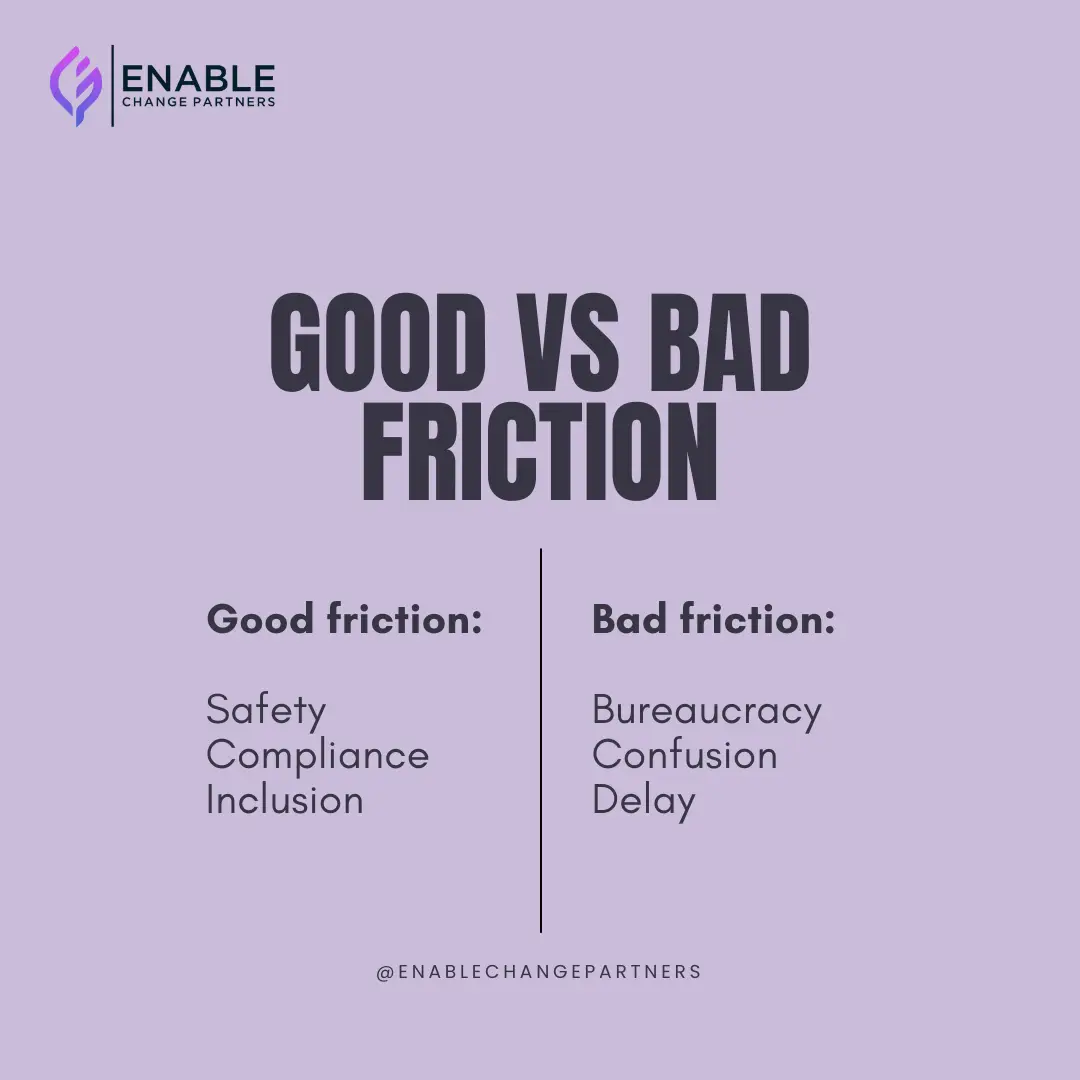
The Difference Between Good and Bad Friction
We help leaders recognise the two kinds of friction:
Good friction
- Creates deliberate pause points for safety, compliance, or inclusion.
- Prompts reflection instead of delay.
- Protects people and decisions.
Bad friction
- Breeds bureaucracy and unnecessary sign-offs.
- Creates confusion about accountability.
- Slows progress without adding value.
When friction is designed intentionally, it supports flow instead of chaos.
Designing for Flow
Our perspective is simple:
Change is not about speed; it is about flow.
Flow happens when the right people slow down for the right reasons while others are empowered to move quickly.
In practice, this means:
- Defining clear decision rights so people know when to pause and when to proceed.
- Creating visible “green lanes” for low-risk decisions.
- Building reflection into governance as a form of protection, not as an obstacle.
Example: The Power of a Pause
In one energy organisation we supported, project leaders introduced a mandatory “five-minute friction pause” before signing off high-risk changes.
That short pause reduced near-miss incidents by 18% in six months, not because people moved slower, but because they thought better.

The Leadership Takeaway
Leaders often believe their job is to remove friction. We suggest their role is to design it intentionally.
In complex systems such as air traffic control, digital banking, or critical infrastructure, the real question is not
“How do we move faster?”
It is
“Where can we move fast, and where can we not?”
Knowing when to slow down is one of the most strategic choices a leader can make.
The best leaders do not fear friction. They design it thoughtfully.
If your transformation feels like it is running faster than your people can think, it might be time to create some good friction.
Your Turn
If your transformation feels like it’s running faster than your people can think, it might be time to create some good friction.
Where in your organisation would a little more friction actually improve flow?
Share your thoughts in the comments. Your perspective might help another leader slow down just enough to get it right.