
Business transformation is no longer an occasional event.
For most organisations, it has become a permanent condition.
Digital transformation, artificial intelligence, regulatory change and evolving workforce expectations mean leaders are navigating continuous change while still being expected to deliver stable performance. In this environment, the challenge is no longer how to launch transformation initiatives. It is how to sustain momentum, realise benefits and protect value while multiple changes unfold at once.
Despite significant investment in technology transformation and organisational change, many organisations struggle to achieve the outcomes they expect. Research and experience consistently point to the same conclusion. The issue is rarely a lack of strategy or ambition. More often, performance is constrained by weak strategy alignment, limited organisational readiness, unclear leadership accountability and governance models that focus on delivery rather than value.
Transformation success is largely determined before delivery begins.
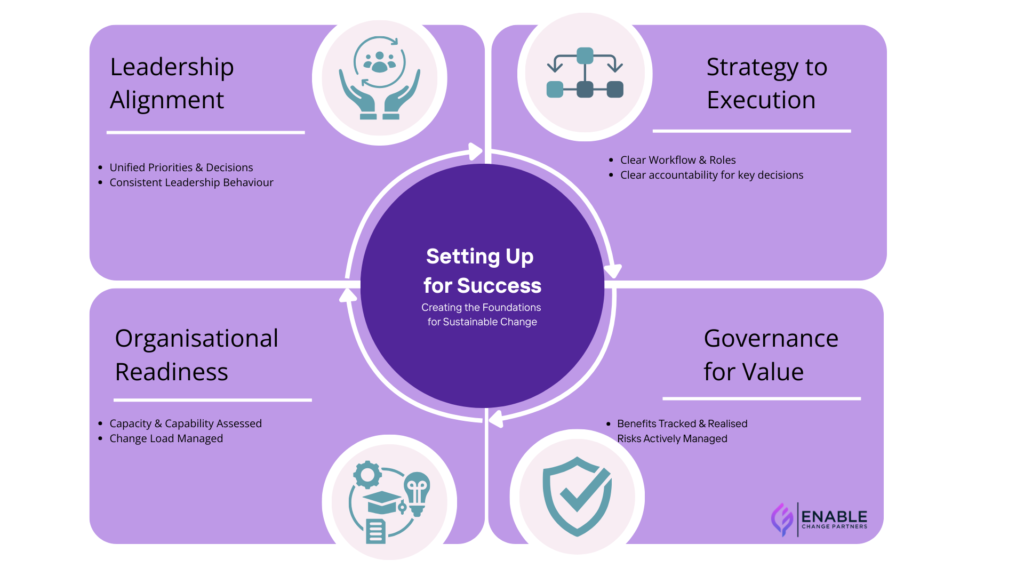
Organisations that perform well take deliberate steps early to set themselves up for success. They align leaders around strategic priorities, translate strategy into how work and decisions must change, assess change capacity realistically, and govern transformation as a benefit realisation and risk management discipline.
As AI becomes embedded in workflows and decision-making, these foundations matter more than ever. Technology amplifies what already exists. Where leadership alignment and operating model clarity are strong, organisations adapt faster and with greater confidence. Where they are weak, value leakage increases.
The organisations that succeed are not those that move fastest, but those that are best prepared to sustain performance as complexity increases.
Why Setting Up for Success Matters More Than Ever
Transformation discussions often focus on execution.
Timelines.
Milestones.
Delivery plans.
Benefits forecasts.
Yet the most consequential decisions are rarely made during delivery. They are made earlier, when leaders set priorities, design governance, allocate capacity and signal what matters most.
This early phase has always been important. Today, it is critical.
Artificial intelligence is reshaping how work is performed and how decisions are made. Change initiatives increasingly overlap rather than follow one another. Leaders are expected to deliver outcomes while managing ongoing disruption, constrained capacity and heightened scrutiny.
Under these conditions, strategy execution capability becomes a strategic differentiator.
Research from McKinsey, Gartner and Prosci consistently shows that organisations that invest early in leadership alignment, organisational readiness and change management are significantly more likely to realise sustainable transformation outcomes. This is not about adding process or slowing progress. It is about making strategy executable in the real world.
When organisations underestimate the importance of set-up, they create friction that no amount of delivery effort can fully overcome. When they invest in it deliberately, execution accelerates naturally.
The Four Conditions That Set Organisations Up for Success
Organisations that consistently deliver value from business transformation focus on four foundational conditions. These conditions reinforce one another and shape how effectively strategy turns into sustained performance.
1. Leadership Alignment
Leadership alignment is often mistaken for agreement or shared messaging. In reality, it is structural.
Aligned leadership exists when leaders share a clear understanding of priorities, trade-offs and expectations, and when that understanding holds under pressure.
This shows up in consistent decision-making, clear ownership of outcomes, and leaders reinforcing the same priorities through their actions.
When leadership alignment is weak, organisations experience mixed signals, delayed decisions and delivery teams compensating for uncertainty. When it is strong, execution accelerates and momentum is sustained.
Setting up for success means creating alignment before delivery noise takes over, not trying to repair it once execution is underway.
2. Translating Strategy Into How Work Changes
Strategy only creates value when it changes how work is done.
High-performing organisations invest time early to translate strategic intent into practical implications for how work is performed. This includes clarity on roles, workflows, accountability for key decisions, escalation paths and performance expectations.
This is particularly important in digital and AI-enabled transformations, where technology adoption without operating model alignment limits benefit realisation.
When this translation is explicit, people understand what is changing and where responsibility now sits. When it is not, decisions stall, accountability blurs and teams default to existing ways of working.
Successful organisations make the impact of strategy visible and actionable, not theoretical.
3. Organisational Readiness and Change Capacity
Readiness is not about enthusiasm. It is about capacity and capability.
Organisations that set themselves up for success assess readiness realistically. They consider competing priorities, leadership capability, workforce skills and the cumulative impact of concurrent initiatives.
Change management research consistently shows that organisations that integrate readiness and change planning early are significantly more likely to meet or exceed objectives. Not because people are more motivated, but because change is designed to fit within real constraints.
Readiness turns ambition into something workable.
4. Governance for Value and Benefit Realisation
Governance is often viewed as a delivery control. In effective organisations, it functions as a value protection mechanism.
Governance for value ensures benefits remain actively owned, risks associated with adoption and behaviour change are visible, and decisions are informed by impact rather than activity alone.
As AI and automation increasingly influence outcomes, governance becomes even more important. Speed without trust creates exposure. Trust without accountability limits scale.
Organisations that govern transformation well create the conditions for both pace and confidence.
AI, Operating Models and Leadership Accountability
AI is accelerating the need for clarity.
As systems increasingly support or execute decisions, organisations must be explicit about accountability for outcomes, escalation pathways and where human judgement applies. These are leadership and operating model questions, not technology questions.
AI does not replace leadership responsibility. It amplifies the consequences of weak design and unclear accountability.
Organisations that are succeeding with AI invest early in leadership capability, clear accountability for key decisions and operating model alignment. Those that do not often find that technology adoption outpaces organisational maturity.
From Mobilisation to Momentum
Many organisations equate gearing up with mobilisation. Teams are formed, programs launched and timelines locked.
High-performing organisations focus instead on momentum.
They sequence initiatives deliberately.
They protect focus.
They make trade-offs explicit.
They assign clear ownership for outcomes.
This approach aligns with research on repeatable strategy execution capability. Sustainable performance is built through coherence and consistency, not heroics.
Momentum is not created by urgency.
It is created by clarity.
A Deliberate Start Is a Leadership Choice
Transformation will continue to accelerate.
New technologies will emerge.
Market conditions will shift.
Expectations will rise.
In this environment, organisations cannot rely on urgency or goodwill to deliver results. Sustainable performance depends on leadership choices made early, often before pressure is visible.
Organisations that consistently realise value from transformation do not treat change as a downstream activity. They recognise it as a core leadership and governance discipline.
They align leaders before delivery begins.
They translate strategy into how work actually changes.
They design with realistic assumptions about capacity and capability.
They govern transformation with a focus on outcomes and benefit realisation.
A deliberate start does not guarantee success.
But without it, success becomes increasingly difficult to sustain.
In an era of continuous business transformation, setting up for success is one of the most important strategic advantages leaders have.